MCC 7995 Explained
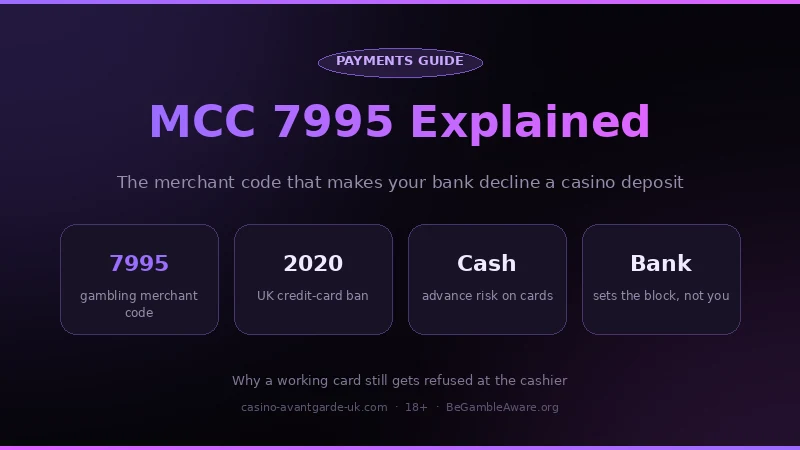
Four digits attached to every casino transaction, invisible to you and decisive for your bank. This is what the gambling merchant category code does and why a working card gets refused.
Last verified: September 2026 | Applies to: Visa, Mastercard, Amex | Relevant to UK card issuers
You put a card into a casino cashier, the balance is fine, the details are right, and the payment fails anyway. Most people conclude the casino is broken. Usually it is not. What has happened is that your bank has looked at four digits travelling alongside the transaction — the merchant category code — seen 7995, and made a decision before the money went anywhere.
MCC 7995 is the card schemes’ code for betting and casino gambling: casinos, sportsbooks, lottery sellers, racetracks, online bingo, and every online casino cashier you will ever use. It is set by the merchant’s acquiring bank, not by the merchant and certainly not by you, and it rides on the authorisation message to your issuer in real time.
It is worth understanding for a practical reason: it explains almost every declined gambling deposit, it explains why gambling spend shows up in your banking app’s spending categories, and on a credit card it explains an expensive surprise that has nothing to do with whether you won.
What the code actually is
Every business that takes card payments is assigned a four-digit merchant category code by its acquirer when the merchant account is opened. The code describes what the business sells — 5411 for grocery stores, 5812 for restaurants, 4121 for taxis. It exists so that card networks, issuers and tax authorities can classify spending without reading a description of every purchase.
7995 is the gambling code. The scheme definition covers betting, including lottery tickets, casino gaming chips, off-track betting and wagers. In practice it is the code attached to online casino and sportsbook deposits worldwide. All three major networks classify it as high risk, which is why it attracts different treatment from a normal retail purchase at almost every stage.
There are neighbouring codes. The schemes maintain separate categories for government-owned lotteries and for online gambling licensed within particular markets — 7801 is the one issuers commonly see for state-regulated online gambling in the United States, and issuers treat that volume more favourably than plain 7995. A UK player depositing at an offshore casino will effectively always see 7995.
Three things follow automatically from that code being present:
- Bank gambling blocks catch it. Every UK gambling block works by matching the merchant category code. It does not matter which casino, which country, or which card — if the code is 7995 and the block is on, the transaction is declined.
- Credit cards may treat it as a cash advance. Buying gambling credit is, to an issuer, closer to withdrawing cash than to buying a jumper. That means interest from day one and usually a handling fee.
- It categorises your spending. The “gambling” line in your banking app, and any spend cap or alert built on it, is driven by this code and nothing else.
What to do when a deposit is declined
Work through these in order. The first two account for the large majority of failures.
1 Check whether your bank’s gambling block is on
It is in the card controls section of your banking app, and at several UK banks it is switched on by default. Turning it off is instant to request but not instant to take effect — most issuers apply a cooling-off period first. Barclays and HSBC use 72 hours, NatWest 48, and others sit between 24 and 72.
2 Confirm you are using a debit card
UK issuers commonly decline gambling transactions on credit cards outright. Where the payment does go through, it is normally billed as a cash advance rather than a purchase.
3 Let the 3-D Secure step complete
The bank’s verification screen opens in a pop-up. Mobile browsers with strict pop-up blocking kill it silently and the cashier reports a generic failure. Allow pop-ups for the cashier domain and try again.
4 Match the name exactly
The cardholder name has to match your registered account name character for character. A middle initial present on one and missing from the other is enough to trigger the fraud filter.
5 Wait an hour and retry
Offshore casinos rotate between acquiring banks. When one route is down, the same card fails now and works later with nothing changed at your end. This genuinely works more often than it should.
6 Split the amount, or switch method
Some card routes carry their own per-transaction ceiling below the advertised maximum. Two smaller deposits often clear where one large one will not — and an e-wallet or crypto route sidesteps the card rails entirely.
What this means for a UK player
The credit-card question is settled at UK-licensed sites and unsettled everywhere else. Since 14 April 2020 the Gambling Commission has banned credit-card gambling at its licensees, online and in person, with a narrow exception for non-remote lotteries. That ban binds the operator. An offshore casino such as Avantgarde is not a UKGC licensee, so the ban does not reach it — but your card issuer still sees code 7995 and applies its own policy, which for most UK credit cards means a decline or a cash advance.
A cash advance is more expensive than people expect. No interest-free period, interest accruing from the transaction date at the cash rate rather than the purchase rate, plus a handling fee that is commonly around 3% with a minimum. Deposit £200 that way, lose it, and the loss is not £200. It is £200 plus the fee plus interest until you clear it, and cash advances are often the last part of a balance to be paid off.
The code follows you offshore. Some players assume an unfamiliar processor name on the statement means the gambling classification has been dodged. It has not. The descriptor is the processor’s trading name; the category code underneath is still 7995, so the block still applies and the spending category still counts it.
Miscoding happens, occasionally. A merchant can be coded incorrectly — a payments intermediary coded as a general service, for instance. That is rare, it is not something you can arrange, and where a gambling payment is processed under a non-gambling code your own protections weaken rather than improve: your gambling block will not catch it, and neither will your spending controls.
The rest of the mechanics — deposit fees, withdrawal timings, what a payout looks like on a statement — are on our Avantgarde payment methods page.
Dates that matter
-
14 January 2020
The Gambling Commission confirms the credit-card gambling ban, giving operators three months to implement it.
-
14 April 2020
The ban takes effect. UKGC-licensed operators can no longer accept credit cards, online or in premises, other than for non-remote lotteries.
-
September–October 2020
UK banks strengthen their own gambling blocks. Barclays introduces a 72-hour delay before a block can be lifted; NatWest adds a 48-hour cooling-off period.
-
2021 onward
HSBC and first direct extend their cooling-off period from 24 hours to 72. Gambling blocks become standard across the high street rather than a challenger-bank feature.
-
Today
MCC 7995 remains the single mechanism behind all of it — blocks, categorisation and cash-advance treatment alike.
Then and now
| Area | Before 2020 | Now |
|---|---|---|
| Credit cards at UK sites | Accepted as a normal purchase | Banned since 14 April 2020 at UKGC licensees |
| Credit cards at offshore sites | Generally worked | Usually declined by the issuer, or billed as a cash advance |
| Bank gambling blocks | A niche challenger-bank feature | Standard across the UK high street, often on by default |
| Lifting a block | Instant toggle | Cooling-off period of 24–72 hours at most issuers |
| Spending visibility | Buried in the statement | Categorised automatically in the banking app from the 7995 code |
Sources
- Gambling Commission — gambling using a credit card, the official statement of the ban and its scope.
- Visa Merchant Data Standards Manual — the scheme definition of merchant category codes, 7995 included.
- Barclays — 72-hour delay on its gambling block, the issuer’s own announcement.
- HSBC UK — gambling block extended to 72 hours.
- GamCare — free, confidential support if blocking payments is not enough on its own.
MCC 7995: your questions
What is MCC 7995?
Why was my casino deposit declined?
Can I stop my bank blocking gambling payments?
Is gambling on a credit card illegal in the UK?
What is a cash advance and why does it matter?
Will using an e-wallet avoid MCC 7995?
Does the code change if the casino is offshore?
Can a casino change its own merchant category code?
Does MCC 7995 affect my credit file?
 Written by Rebecca Cassidy, Gambling Anthropologist, Goldsmiths, University of London
·
Published
·
Last checked
Written by Rebecca Cassidy, Gambling Anthropologist, Goldsmiths, University of London
·
Published
·
Last checked