Avantgarde Payment Methods
Cards, e-wallets, vouchers, bank wire and five cryptocurrencies — settled in USD and EUR, never in pounds. Here is what each one actually costs a UK player.
Last verified: September 2026 | Operator: Avantgarde Casino | Curacao Licence: Antillephone 8048/JAZ
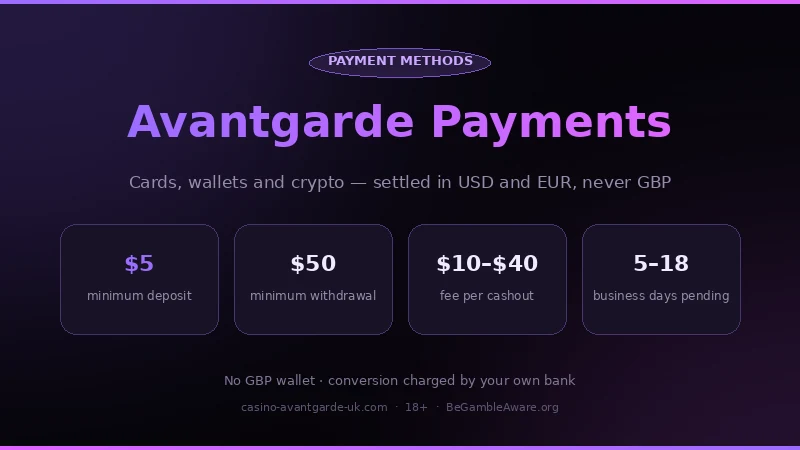
Payments are where an offshore casino either earns your trust or loses it, and Avantgarde is a good example of why the deposit page and the withdrawal page rarely tell the same story. Getting money in is easy: seventeen-odd methods, a $5 floor, instant credit on almost everything. Getting money out is a different exercise — a $50 minimum, a flat $10–$40 fee on every single request, and a published pending window of 5 to 18 business days before the payment even leaves the operator.
The other thing to fix in your head before you read the tables: there is no GBP wallet here. Avantgarde settles in US dollars, euros and a handful of cryptocurrencies. Every figure on this page is in dollars because that is what your account balance will be denominated in. Your bank does the pound-to-dollar conversion at its own rate and adds its own non-sterling fee, typically somewhere between 2.75% and 3% at a UK high-street bank, and it does that twice — once on the way in, once on the way out.
We have set out every method below with the limits, the speed and the cost, plus the parts nobody advertises: what the transaction looks like on your bank statement, why a perfectly good card gets refused at the cashier, and the mistakes that turn a three-day withdrawal into a three-week one.
Banking rails: how the money actually moves
Underneath the logos in the cashier there are only four routes a payment can take, and each one behaves differently once it crosses out of the UK banking system.
Card rails (Visa, Mastercard, Amex, Discover). Your deposit is authorised in seconds and appears in the balance immediately, but it is processed by an acquirer outside the UK under the gambling merchant category code. That code is the reason UK issuers treat it as a special class of transaction — we have written up the whole mechanism on our MCC 7995 page. Payouts back to a card go through a separate refund-style flow that adds days on top of the pending period.
Bank wire. This is a straight international transfer, not a Faster Payment. It clears in 3–7 business days on a good run and can stretch past ten when a correspondent bank sits in the middle. Wires are the only sensible route for four-figure cashouts, and they are the one method where your own bank may ask you what the money is for.
E-wallets (Skrill, Neteller, eZeeWallet, Jeton). The wallet holds a dollar or euro balance, so the casino-to-wallet leg is quick and cheap. The conversion cost simply moves one step down the chain: it lands when you pull money out of the wallet into your UK current account.
Crypto (BTC, ETH, LTC, USDT, USDC). Once a withdrawal is approved, this is the fastest leg on the board — minutes to an hour depending on network congestion. What it does not do is shorten the approval queue, which is where the real delay sits. Anyone telling you crypto makes Avantgarde pay out in a day has skipped the 5–18 business-day pending stage that happens before a single satoshi moves.
Two rails that UK players expect and will not find here at all: PayPal and Apple Pay. Both companies restrict casino processing to operators licensed in the player's own jurisdiction, and a Curacao licence does not qualify. There is no Pay by Bank / open-banking option either.
E-wallets and vouchers
Wallets are the most-used route at offshore casinos for a simple reason: they keep the casino's name off your bank statement and they are the only method here that is reliably two-way. Vouchers are deposit-only — useful for capping your spend, useless when you want paying.
Two-way wallets
- Skrill — deposit and withdraw, 1–3 days after approval
- Neteller — same behaviour, same operator (Paysafe)
- eZeeWallet — euro-first, smaller UK footprint
- Jeton — works, but expect an extra ID check
Bonus note: many Curacao brands exclude wallet deposits from the welcome offer. Read the terms in the cashier before you fund with Skrill or Neteller.
Deposit-only vouchers
- Paysafecard — prepaid PIN, bought in shops
- Neosurf — same idea, wider in the EU than the UK
- CASHlib — prepaid voucher, deposit only
If you fund with a voucher you will still have to nominate a different method for withdrawal, and that method has to be in your own name.
One rule governs all of them and it catches people out constantly: the account you withdraw to has to match the account you deposited from, and it has to be in your own name. Fund with a Paysafecard PIN and try to cash out to a friend's Skrill and the request will be voided, not just delayed. If you plan to withdraw by wallet, make the very first deposit from that same wallet.
Debit cards — and why credit cards are a trap
Visa and Mastercard debit are the default deposit method for most UK players and they work here, subject to your issuer allowing gambling transactions at all. Deposits are instant. What is unusual by UK standards is the deposit fee: card funding at Avantgarde carries a processing charge in the region of 3–6.5% depending on the acquirer that picks up the transaction. At a UKGC-licensed site a deposit fee of any kind would be remarkable; here it is routine, and it is applied before the money reaches your balance, so a $100 deposit can credit as $93.50.
Avantgarde's cashier also lists Amex and Discover. Both are accepted on paper and both fail more often than Visa or Mastercard in practice, because far fewer offshore acquirers support them.
Credit cards are the part to take seriously. Since April 2020 the Gambling Commission has banned credit-card gambling at UKGC-licensed operators. Avantgarde is not UKGC-licensed, so the ban does not bind it — but it does not have to. Your UK card issuer sees the gambling merchant code and, on a credit card, most issuers now either decline the transaction outright or process it as a cash advance: interest from day one at the cash rate, no interest-free period, and usually a separate cash-advance handling fee of around 3%. That is a cost you carry whether you win or lose. Use a debit card, or do not use a card.
A last practical point on card withdrawals. Money going back to a card is pushed as a refund against the original deposit, so the card you used has to still be live and unexpired. Replace a lost card between depositing and cashing out and the payout will bounce back to the operator, at which point you are into a support ticket and another verification round.
Why your payment was declined
A refused deposit almost never means "no money in the account". Nine times in ten it is one of the following, and the fix is different in each case.
Your bank blocks gambling merchants
Most UK banks now ship a gambling block, and several turn it on by default for new accounts. It is keyed to merchant code 7995, so it catches the casino no matter which card you use. Turn it off in the app and note that a 48–72 hour cooling-off period applies before the change takes effect at Monzo, Starling, Lloyds, Halifax and others.
The card is a credit card
Increasingly declined by the issuer rather than the casino. If it does go through, it is likely to be treated as a cash advance.
3-D Secure did not complete
The step-up screen opens in a pop-up. Mobile browsers with aggressive pop-up blocking silently kill it and the cashier reports a generic failure. Allow pop-ups for the cashier domain and retry.
Name mismatch
The cardholder name has to match the registered account name character for character. A middle initial on the card that is missing from the profile is enough to trip the fraud filter.
Acquirer routing
Offshore casinos rotate between acquiring banks. One route being down means a card that worked last month fails today with no explanation. Waiting an hour and retrying genuinely does work here.
Below the floor or above the ceiling
The minimum is $5. Some card routes impose their own per-transaction ceiling well under the advertised maximum, so a large deposit split into two smaller ones will often clear when one big one will not.
Every Avantgarde payment method compared
Limits are per transaction and quoted in USD, the currency your Avantgarde balance is held in. "Payout time" is the time after the pending period and any KYC review have cleared — not the time from clicking withdraw.
| Method | Min deposit | Deposit speed | Deposit fee | Withdrawal | Payout time |
|---|---|---|---|---|---|
| Visa debit | $5 | Instant | 3–6.5% | Yes | 3–7 business days |
| Mastercard debit | $5 | Instant | 3–6.5% | Yes | 3–7 business days |
| American Express | $5 | Instant | 3–6.5% | Rarely | 5–10 business days |
| Discover | $5 | Instant | 3–6.5% | Rarely | 5–10 business days |
| Skrill | $10 | Instant | None | Yes | 1–3 business days |
| Neteller | $10 | Instant | None | Yes | 1–3 business days |
| eZeeWallet | $10 | Instant | None | Yes | 1–3 business days |
| Jeton | $10 | Instant | None | Yes | 1–3 business days |
| Paysafecard | $10 | Instant | None | No | — |
| Neosurf | $10 | Instant | None | No | — |
| CASHlib | $10 | Instant | None | No | — |
| Bank wire | $50 | 1–3 business days | Bank charges | Yes | 3–10 business days |
| Bitcoin (BTC) | $20 equivalent | 10–60 min | Network fee | Yes | Under 1 hour |
| Ethereum (ETH) | $20 equivalent | 5–30 min | Network fee | Yes | Under 1 hour |
| Litecoin (LTC) | $20 equivalent | 5–20 min | Network fee | Yes | Under 1 hour |
| Tether (USDT) | $20 equivalent | 5–30 min | Network fee | Yes | Under 1 hour |
| USD Coin (USDC) | $20 equivalent | 5–30 min | Network fee | Yes | Under 1 hour |
Run the arithmetic on the fee before you cash out, because it is a percentage that moves. Withdraw the $50 minimum and a $40 fee takes 80% of it. Withdraw $500 and the same fee is 8%. If you are going to accept the cost at all, cash out in larger, less frequent amounts — and never leave a balance sitting on the site to "save on fees", because an offshore balance is an unsecured claim against the operator, not money in a bank.
How the deposit shows up on your bank statement
The name that appears on your statement is the payment processor's, not the casino's. Offshore operators route through a rotating set of intermediaries, so a series of deposits made a fortnight apart can produce three different descriptors. Expect a short trading name you do not recognise, often followed by a city that has nothing to do with anything — Limassol, Valletta, Nicosia and Willemstad are the usual suspects — and a reference number.
Three things follow from that. First, the transaction will be flagged as an international payment, which is where the non-sterling fee comes from. Second, it will still carry the gambling merchant code, so it will still count toward any gambling block or spending category in your banking app even though the name is unfamiliar. Third, if you ever need to query a payment, quote the date, the exact amount in dollars and the descriptor as printed — your bank will not be able to find "Avantgarde".
The same applies in reverse to a payout. A card withdrawal appears as a refund against the original deposit line rather than as a fresh credit, and it can take a further two or three days to post after the operator marks it as sent. A wire arrives as an inbound international transfer, sometimes with a small correspondent charge deducted en route.
Keep your own record: date, method, amount, and a screenshot of the cashier confirmation. If a payment goes missing, that record is the only thing you have — there is no UK Alternative Dispute Resolution route for a Curacao-licensed site, so no IBAS, no eCOGRA, and the Financial Ombudsman will not look at a gambling loss.
Common mistakes that delay a payout
Leaving KYC until you win
Verification on a first cashout can add up to 18 business days on top of the pending period. Upload ID, proof of address and a card image the day you register and the clock runs while you play instead of after.
Cancelling a pending withdrawal
The cashier lets you reverse a pending request back into your balance. Every reversal restarts the pending window from zero, and it is the single most common reason a payout that should have taken a week takes a month.
Withdrawing to a different method
Payouts are returned along the deposit route first. Ask for a wire when you funded by card and expect the request to be rejected and re-queued.
Cashing out with bonus funds live
Any active bonus locks the balance. Requesting a withdrawal before the wagering is finished forfeits the bonus and any winnings attached to it — the terms are explicit about this.
Ignoring the 10x cash-out cap
Winnings from bonus play are capped at ten times the qualifying deposit. Deposit $20 on a bonus and $200 is the ceiling regardless of what the balance says.
Blowing past the fee
Three $60 withdrawals cost up to $120 in fees. One $180 withdrawal costs up to $40. The fee is per request, not per pound.
Then and now: what has changed for UK players
Paying an offshore casino from a UK bank account is materially harder than it was five years ago. Most of that change came from the banks and the card schemes rather than from the casinos.
| Area | Then | Now |
|---|---|---|
| Credit cards | Accepted almost everywhere, treated as a normal purchase | Banned at UKGC sites since April 2020; at offshore sites usually declined or billed as a cash advance |
| Bank gambling blocks | A niche feature at one or two challenger banks | Standard across the UK high street, often on by default, with a 48–72 hour cooling-off before it can be lifted |
| PayPal | Widely available for UK gambling | Restricted to operators licensed in the player’s jurisdiction — unavailable here |
| Crypto | Fringe option, few brands supported it | Five coins accepted, and the fastest route once a payout is approved |
| Withdrawal fees | Uncommon; UK sites competed on free cashouts | A flat $10–$40 per request at Avantgarde, regardless of method |
| Verification | Often deferred until a large win | Documents demanded on the first cashout, adding up to 18 business days |
Payment questions, answered
Can I deposit at Avantgarde in British pounds?
What is the minimum deposit at Avantgarde?
What is the minimum withdrawal?
Does Avantgarde charge withdrawal fees?
How long does an Avantgarde withdrawal take?
Does Avantgarde accept PayPal or Apple Pay?
Can I use a credit card?
Why does my bank block the deposit?
What name appears on my bank statement?
Can I withdraw to a different account from the one I deposited with?
Is crypto really faster?
Are my funds protected if the casino fails?
 Written by Rebecca Cassidy, Gambling Anthropologist, Goldsmiths, University of London
·
Published
·
Last checked
Written by Rebecca Cassidy, Gambling Anthropologist, Goldsmiths, University of London
·
Published
·
Last checked