Northern Ireland Gambling Law
The one part of the UK that the Gambling Act 2005 never reached. Here is what actually governs online play in Northern Ireland, and what it leaves you without.
Last verified: September 2026 | Jurisdiction: Northern Ireland | Governing law: the 1985 Order, as amended in 2022
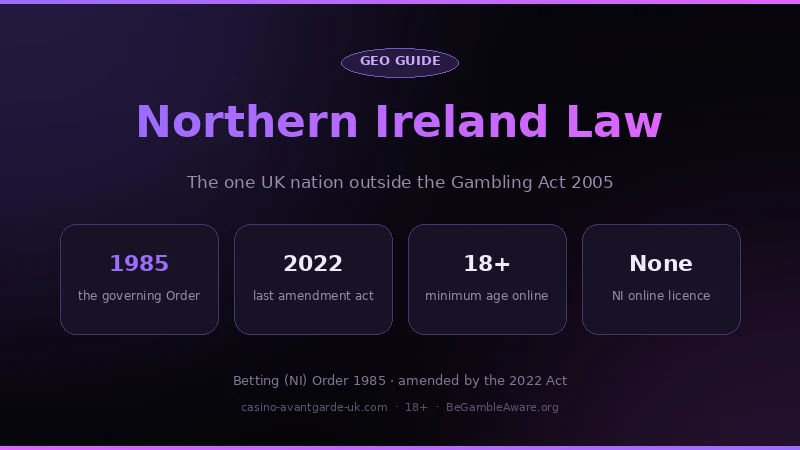
Almost everything written about UK gambling law is written about Great Britain. Northern Ireland is the exception, and it is not a small one: the Gambling Act 2005 does not extend there at all. Gambling in Northern Ireland is still governed by the Betting, Gaming, Lotteries and Amusements (Northern Ireland) Order 1985, drafted for betting shops, bingo halls and fruit machines in a world without the internet, and amended once in a generation.
The practical consequence catches people out. Because the 1985 Order predates online gambling, it contains no licensing regime for it. There is no Northern Ireland online casino licence, no Northern Ireland gambling regulator equivalent to the Gambling Commission, and nothing an operator serving players in Belfast, Derry or Newry is required to hold. Gambling policy sits with the Department for Communities; day-to-day licensing of physical premises sits with the courts and district councils. Neither touches a website.
That is the frame for everything below, including the part that matters most: playing online from Northern Ireland is not a criminal act for you as a player, but the consumer protections you might assume are behind you very often are not.
The substance of the rule
The Gambling Act 2005 covers Great Britain, not the UK. England, Wales and Scotland. Everything that flows from it — the Gambling Commission, remote operating licences, the licence conditions and codes of practice, the advertising rules, the recent statutory levy on operators — is a Great Britain framework. Northern Ireland was deliberately left out at the time and has never been brought in.
The 1985 Order is what applies instead. It licenses bookmaking offices, bingo clubs, gaming machines and lotteries as physical activities in physical places. It sets the minimum age at 18 for betting and most commercial gambling. It says nothing about remote gambling, because in 1985 there was none to say anything about.
The 2022 Amendment Act modernised the edges, not the middle. The Betting, Gaming, Lotteries and Amusements (Amendment) Act (Northern Ireland) 2022 received Royal Assent on 26 April 2022. It let bookmakers and bingo halls open on Sundays and Good Friday for the first time, tightened the rules on under-18s in betting premises, and provided for a statutory code of practice on responsible gambling — the code provision commenced on 1 October 2023. What it did not do was create an online licensing regime. That was always framed as a second phase of reform, and that second phase has not arrived.
No statutory levy. Great Britain now funds research, prevention and treatment through a levy on licensed operators. Northern Ireland has no equivalent, so treatment services there are funded differently and more thinly. It is one of the clearest illustrations of what being outside the 2005 Act actually costs.
So who regulates the site you are playing on? Whoever licensed it, wherever that is. For a UKGC-licensed operator that accepts customers in Northern Ireland, you get the benefit of the Commission’s rules as a matter of the operator’s own licence conditions rather than because a Northern Irish law requires it. For a Curacao-licensed operator such as Avantgarde, you get whatever Curacao requires — which, as we set out in our review, is not much.
Dates and deadlines
How the law got to where it is, and what is still outstanding.
-
1985
The Betting, Gaming, Lotteries and Amusements (Northern Ireland) Order 1985 is made. It becomes, and remains, the primary gambling law in Northern Ireland.
-
2005
The Gambling Act 2005 passes at Westminster and creates the Gambling Commission — for Great Britain only. Northern Ireland is not included.
-
2019–20
The Department for Communities runs a public consultation on regulating gambling in Northern Ireland. The response shows broad appetite for reform from the industry and from campaigners alike.
-
26 April 2022
The Betting, Gaming, Lotteries and Amusements (Amendment) Act (Northern Ireland) 2022 receives Royal Assent — the first substantial change in nearly forty years.
-
1 October 2023
The Act’s code of practice provision commences, alongside the first commencement order bringing other sections into operation.
-
Ongoing
A second phase of reform — which would be the vehicle for any online licensing regime and any statutory levy — remains policy intention rather than law. No timetable has been fixed.
What this means if you play online from Northern Ireland
You are not breaking the law by playing. The 1985 Order regulates the supply of gambling, not the act of placing a bet online as a consumer. No player in Northern Ireland has been prosecuted for using an online casino, and there is no offence that would apply.
But nothing on the operator’s side is guaranteed by Northern Irish law either. No local licence to check, no local regulator to complain to, no local rules on advertising, bonus terms, affordability or complaint handling. Whatever protection you have comes from the operator’s own licence — so the licence is the only thing worth checking.
A UKGC-licensed operator is still the stronger position. Its licence conditions bind it wherever the customer is, so you get GAMSTOP coverage, mandatory ADR, segregated-funds disclosure, the £5 slot stake cap and the rest, as a matter of that operator’s obligations. GAMSTOP itself works for players in Northern Ireland — it operates on the operator’s side, and every UKGC remote licensee has to be signed up to it.
A Curacao-licensed operator gives you none of that, anywhere in the UK. That includes Avantgarde. No GAMSTOP, no IBAS, no eCOGRA, no regulator that answers a complaint about a slow payout. Being in Northern Ireland does not make that better or worse than being in Belfast’s equivalent in Manchester — it is the same gap. What Northern Ireland adds is that there is no local backstop either.
Money and disputes. UK banking rules apply as normal: gambling blocks, merchant code 7995, the credit-card cash-advance treatment. The Financial Ombudsman can look at how your bank handled a payment; it cannot look at a gambling dispute with a casino. If a payout stalls at an offshore operator, live chat and public complaint forums are, realistically, the whole of your leverage.
Northern Ireland versus Great Britain
| Area | Great Britain | Northern Ireland |
|---|---|---|
| Primary law | Gambling Act 2005 | Betting, Gaming, Lotteries and Amusements (NI) Order 1985, amended 2022 |
| Regulator | Gambling Commission | No dedicated regulator; policy sits with the Department for Communities |
| Online licensing | Remote operating licence required to serve GB customers | No online licensing regime exists |
| Statutory levy on operators | Yes | No |
| Statutory code of practice | Licence conditions and codes of practice | Code of practice provision in force since 1 October 2023 |
| Sunday / Good Friday betting shops | Permitted | Permitted only since the 2022 Act |
| Minimum age | 18 for casino, betting and online | 18 for betting and most commercial gambling |
| Self-exclusion | GAMSTOP, mandatory for UKGC remote licensees | GAMSTOP still works — via the operator’s UKGC licence, not local law |
Checklist before you play from Northern Ireland
Check the licence, not the marketing
Find the licence line in the site footer and verify it on the issuing regulator’s own register. A UKGC number can be checked on the Commission’s public register in seconds; a Curacao number tells you far less.
Assume no local recourse
There is no Northern Ireland gambling regulator to escalate to. If the operator is not UKGC-licensed, there is no ADR route either.
Set your limits at the bank
If the casino has no self-serve deposit limits — Avantgarde does not — your bank’s gambling block and card controls are the tool you actually have.
Register with GAMSTOP anyway
It covers every UKGC remote licensee and works from Northern Ireland. It will not cover offshore sites, which is exactly why it is worth knowing which sites those are.
Use a debit card, never credit
Credit-card gambling is banned at UKGC sites and treated as a cash advance almost everywhere else, with interest from day one.
Keep your own records
Date, amount, method and a screenshot of every deposit and withdrawal confirmation. With no regulator behind you, your records are the case.
Sources
Everything on this page comes from primary legislation or the responsible department. Check them yourself — they are all public.
- Betting, Gaming, Lotteries and Amusements (Northern Ireland) Order 1985 — the primary law, on legislation.gov.uk.
- Betting, Gaming, Lotteries and Amusements (Amendment) Act (Northern Ireland) 2022 — the amending Act as enacted.
- Commencement No. 1 Order (Northern Ireland) 2023 — which sections came into operation, and when.
- Department for Communities — the department responsible for gambling policy in Northern Ireland.
- Gambling Commission public register — where to confirm whether an operator holds a UKGC licence.
- GAMSTOP — free self-exclusion covering UKGC remote licensees, available across the UK.
Northern Ireland gambling law: your questions
Is online gambling legal in Northern Ireland?
Does the Gambling Act 2005 apply in Northern Ireland?
Who regulates gambling in Northern Ireland?
What did the 2022 Act change?
Can I use GAMSTOP in Northern Ireland?
Is Avantgarde legal for a player in Northern Ireland?
What is the minimum gambling age in Northern Ireland?
Is there a statutory gambling levy in Northern Ireland?
Do UK slot stake limits apply in Northern Ireland?
 Written by Rebecca Cassidy, Gambling Anthropologist, Goldsmiths, University of London
·
Published
·
Last checked
Written by Rebecca Cassidy, Gambling Anthropologist, Goldsmiths, University of London
·
Published
·
Last checked